For decades, we’ve understood the nervous system through a simple lens: fight or flight.
But this model is incomplete.
Developed by Dr. Stephen Porges, Polyvagal Theory offers a far more sophisticated understanding of how we respond to the world, especially under pressure. It explains why high-performing leaders can feel calm one moment and overwhelmed the next, why burnout happens even when everything “looks fine,” and why true performance isn’t just mental – it’s physiological.
At the center of this theory is the vagus nerve: a powerful communication pathway between your brain and body.
The Vagus Nerve: Your Internal Command System
Think of the vagus nerve as a bi-directional information highway.
It connects your brain to your:
- Heart
- Lungs
- Digestive system
- Facial muscles and voice
This means your state of mind is not just cognitive – it’s embodied.
When your nervous system is regulated, you:
- Think clearly
- Make better decisions
- Communicate effectively
- Stay resilient under pressure
When it’s dysregulated, everything shifts.
The Three States of the Nervous System
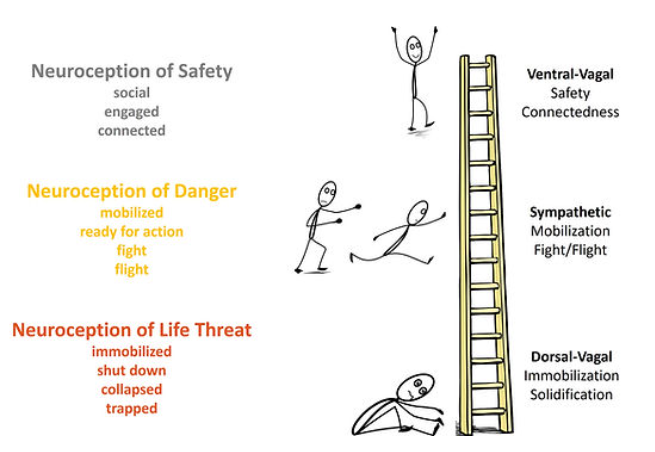
Polyvagal Theory maps the nervous system into three core states.
1. Ventral Vagal (Safety & Connection)
This is your optimal performance state.
Physiology:
- Steady heart rate
- Deep, regulated breathing
- Relaxed facial expression
Experience:
- Calm, focused, present
- Connected to others
- Clear thinking and creativity
This is where:
- Leadership thrives
- Innovation happens
- Relationships deepen
2. Sympathetic (Mobilisation / Fight or Flight)
This state activates when your system detects threat or pressure.
Physiology:
- Increased heart rate
- Shallow breathing
- Heightened alertness
Experience:
- Anxiety, urgency, frustration
- Overthinking and reactivity
- “Running hot”
In modern life, this often shows up as:
- Chronic stress
- Burnout cycles
- High output, low sustainability
3. Dorsal Vagal (Shutdown / Freeze)
When stress becomes overwhelming, the system shifts into shutdown.
Physiology:
- Low energy
- Slowed digestion
- Numbness or heaviness
Experience:
- Disconnection
- Fatigue
- Lack of motivation
- “Checked out”
This is often misinterpreted as:
- Laziness
- Lack of discipline
When in reality, it’s protection.
Neuroception: Why Your Body Decides Before Your Mind
A key concept in Polyvagal Theory is neuroception: your body’s unconscious scanning for safety or danger.
This happens before conscious thought.
Which means:
- Your reactions are not always a choice
- Your nervous system is constantly prioritising survival
- Your “state” shapes your behaviour
Why This Matters for Leaders and High Performers
Most leadership strategies focus on:
- Mindset
- Strategy
- Execution
But ignore the foundation:
Your nervous system capacity.
If your system is dysregulated:
- Decision-making slows
- Emotional reactivity increases
- Cognitive bandwidth shrinks
- Relationships suffer
At a certain level of leadership, the constraint is no longer strategy or capability.
It’s state.
Regulation, Not Perfection
The goal is not to stay calm all the time.
That’s unrealistic.
The goal is:
To move fluidly between states and return to safety faster.
This is resilience.
Practical Ways to Regulate Your Nervous System
These are simple, science-backed tools to activate the vagus nerve:
1. Lengthen Your Exhale
Longer exhales activate the parasympathetic system (calm state).
2. Use Your Voice
Humming, chanting, or speaking slowly stimulates the vagus nerve directly.
3. Cold Exposure
Cold water on the face can reset your nervous system quickly.
4. Eye Contact & Connection
Safe human connection signals your system that you’re not alone.
Final Thought
Your nervous system is not a weakness.
It’s your greatest asset.
And when you learn to work with it – not against it – you unlock a completely different level of leadership, performance, and wellbeing.
Corporate Workshops available which are educational and empowering, immersive and educational on the nervous system and how to self-regulate for wellbeing and performance.


View comments
+ Leave a comment